
Why Converting Cold Traffic Is The Most Expensive Mistake in Marketing
The Hidden Cost No One Talks About
Most marketers don’t realize they’re solving the wrong problem.
They spend hours optimizing ads. Testing creatives. Tweaking funnels. Watching cost per acquisition climb month after month… and assuming that’s just how marketing works now.
But what if the problem isn’t your ads?
What if the real issue is what you’re asking your ads to do?
Because when you expect cold traffic to convert into buyers, you’re not just making things harder…
You’re making them unnecessarily expensive.
The Real Role of Media Buying (And Why It’s Being Misused)
Media buying is powerful. But it’s also misunderstood.
At its core, paid traffic does one thing extremely well:
👉 It gets attention.
That’s it.
It interrupts. It introduces. It creates awareness.
But most marketers push it far beyond that role. They expect it to:
Build trust instantly
Overcome skepticism
Justify a purchase decision
Close the sale
That’s a lot to ask from a single click.
And that’s exactly why it becomes expensive.
When you force ads to convert cold prospects, you’re paying a premium for something that doesn’t naturally happen in one interaction.
Why Converting Cold Traffic Drives Up Costs
Let me break this down simply.
When someone sees your ad for the first time, they don’t know you. They don’t trust you. And they’re not ready to buy.
So in order to convert them, your ad has to do all of this at once:
Capture attention
Build credibility
Explain your offer
Overcome objections
Create urgency
Trigger action
That’s a heavy lift.
And because it’s such a heavy lift, only a small percentage of people convert.
Which means:
Your conversion rates stay low
Your cost per acquisition increases
Your ROAS becomes harder to maintain
So you compensate by spending more.
And that’s where most marketers get stuck.
They think the solution is better ads…
But the real solution is changing the job of the ad.
The Smarter Alternative: Buy Leads, Not Customers
Instead of forcing ads to convert buyers…
Use them to generate leads.
This is where everything changes.
When your only goal is to turn attention into an email subscriber, the price of success drops significantly.
You’re no longer asking for:
A financial commitment
Immediate trust
A final decision
You’re simply asking for:
“Are you interested enough to keep learning?”
That’s a much easier yes.
And because it’s easier:
Conversion rates go up
Cost per lead goes down
Your ad performance improves
But more importantly…
You’ve now moved the relationship into a place you control.
Why Email Is the Real Conversion Engine
Once someone joins your email list, the dynamic shifts completely.
Now you’re no longer interrupting them.
You’re building a relationship.
Email gives you the ability to:
Show up consistently
Share ideas and insights
Demonstrate understanding
Build familiarity over time
And this matters because people don’t buy when they see you…
They buy when they trust you.
Email creates the environment where that trust can develop naturally.
It allows you to:
Answer questions before they’re asked
Address objections without pressure
Position your offer in context
Guide the decision instead of forcing it
And because of that, conversion becomes easier.
Not because your offer changed…
But because the relationship did.
The Economics of Trust: Where ROAS Actually Comes From
There’s a reason email marketing consistently outperforms other channels in return on investment.
It’s not magic.
It’s math.
When you generate a lead once, you can communicate with that person repeatedly without paying again.
That means:
Your cost to reach them drops to near zero
Your opportunities to convert increase over time
Your revenue per lead grows
Compare that to paid ads, where every interaction costs money.
With email, you’re leveraging the same acquisition cost across multiple touchpoints.
That’s why the return compounds.
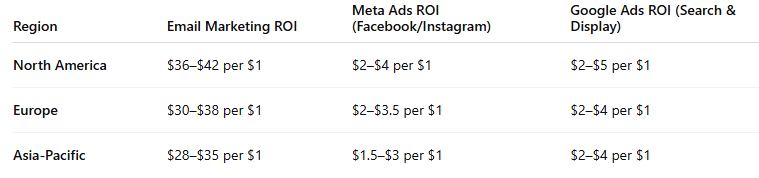
What The Data Actually Shows:
Sources:
Litmus “State of Email ROI” reports
HubSpot Marketing Benchmark Reports
Statista Digital Advertising ROI datasets
Google Economic Impact & Ads Performance Reports
These numbers vary slightly by industry, but the relationship between them stays consistent:
Email doesn’t just perform better. It operates on a completely different level of efficiency.
This aligns with broader industry findings showing email generating significantly higher ROI than other channels .
Why This Gap Exists:
Paid media is a rented channel.
Every impression, every click, every conversion comes with a cost.
Email is an owned channel.
Once the relationship exists, you’re no longer paying to continue the conversation.
So the equation changes:
Ads = linear cost
Email = compounding return
And that compounding effect is what most marketers underestimate.
Because they’re focused on the first conversion…
Instead of the lifetime value created after it.
The Most Overlooked Profit Driver: Repeat Buyers
Here’s where things get even more interesting.
Most marketers focus almost entirely on the first purchase.
But the real profit doesn’t come from the first sale.
It comes from what happens after.
Let’s look at the economics:
The first purchase is burdened by acquisition cost
It’s also reduced by cost of goods sold
Which means margins are often thin
But once someone becomes a customer…
You don’t pay to acquire them again.
So when they buy again:
There’s no acquisition cost
The relationship already exists
Trust is already established
Which means the revenue from repeat purchases is significantly more profitable.
In many cases, it’s almost pure profit.
And email is the channel that makes this possible.
Because it keeps the relationship alive.
Media Buying vs. Email: A Clear Contrast
Let me simplify the difference even further:
Media Buying
Expensive per interaction
Best for attention and lead generation
Weak at building trust quickly
High pressure to perform immediately
Email Marketing
Near-zero cost per interaction
Best for nurturing and conversion
Strong at building trust over time
Compounds value with each message
When you combine them correctly, they stop competing…
And start working together.
The System That Actually Works
Here’s the shift:
Use media buying to capture attention and generate leads
Use email to build trust and convert those leads into buyers
Use email to turn buyers into repeat buyers
This creates a system where:
Ads become more efficient
Conversions become easier
Profit becomes predictable
And most importantly…
You stop relying on a single moment to do all the work.
You Don't Have an Ad Problem
If your costs are rising and conversions feel harder…
It’s not because your ads are broken.
It’s because your system is.
You’re asking cold traffic to do something it’s not ready to do.
And you’re paying the price for it.
But when you shift your focus from forcing conversions to building trust…
Everything changes.
If you want a system you can actually explain, defend, and improve…
Start by rethinking the role of your ads.
Then build your email strategy around trust, not transactions.
That’s where the real leverage is.
The goal isn’t to make ads perform like email, or vice-versa.
That’s the mistake.
The goal is to let each channel do what it does best:
Ads generate attention
Email builds and converts trust
Retention drives profit
When you align the system this way, ROAS stops being something you chase…
And starts becoming something you build.


Sell With Email
1097 Hanover Court S.
Salem, Oregon, United States of America, 97302
© 2026 Sell With Email